At the beginning of the last century, Bediuzzaman Said Nursi offered this striking reminder: “If we were to demonstrate the truths of Islam and the morality of the Qur’an through our conduct and actions—in other words, by living them...” Today, this is precisely what is expected of Muslims in America: to embody Islamic values in everyday life.
Letter from America: Research – Part 1
Bridges and Barriers: Interfaith Engagement in America Under the Shadow of Rising Islamophobia
I would like to begin this week's Letter from America with a research report that landed on my desk a few days ago and has occupied my thoughts ever since. As an academic living in the United States, I see every day that learning to live with differences is one of this country's greatest tests. I witness both its hopeful and its troubling dimensions firsthand.
Last week, at a meeting on campus, I watched a rabbi, a pastor, and a young Muslim student sitting side by side, working together on a project to support immigrant families in the city.
That same evening, however, I listened on television to a politician making hurtful remarks targeting Muslims.
That is America’s two faces: on the very same day, you can encounter both bridges and walls.
What I observe on university campuses, at neighbourhood meetings, and in the courtyards of mosques and churches, when combined with the findings of this report, paints a thought-provoking picture of America’s present—and perhaps its future.
Nina M. Fernando and Erum Ikramullah: The Architects of the Report
The report I am referring to is a joint project by the Institute for Social Policy and Understanding (ISPU)—known for its objective research on American Muslims—and the Shoulder to Shoulder Campaign, which has brought together American religious leaders since 2010 to combat anti-Muslim discrimination.
Published at the beginning of July under the title Bridges and Barriers, the study draws on ISPU’s 2025 American Muslim Poll and, for the first time, presents nationally representative data on Americans’ participation in interfaith initiatives.
A Historical Note Before We Turn to the Report
Interfaith dialogue is hardly a recent invention in America. As the report reminds us, Muslims’ contribution to these lands reaches back even before the nation’s founding.
The civil rights movement of the 1960s—one of the defining struggles for justice in modern American history—was deeply rooted in faith and advanced through alliances among religious communities under the leadership of Black religious leaders.
After September 11, America’s interfaith movement increasingly took on the character of openly standing alongside Muslims and Sikhs who had become targets of Islamophobia. Yet the transformation of this longstanding tradition into an organised, well-funded field taught in universities did not occur until the closing decades of the twentieth century.
In other words, while the history of interfaith engagement is long, its institutionalisation is comparatively recent.
Let Me Begin with the Uncomfortable Truth
The report documents that approval of Islamophobic prejudices has risen sharply since 2022.
More strikingly, this increase is not confined to marginal or extremist circles; it is taking place within the heart of mainstream religious communities.
According to ISPU’s Islamophobia Index, the steepest rise in anti-Muslim attitudes between 2022 and 2025 was recorded among White Evangelicals, with an increase of 15 points. They are followed by Catholics, whose score rose by 12 points, and Jewish respondents, whose score increased by 11 points.
At a time when growing numbers of studies point to the corrosive effects of political and social polarisation on American democracy and social cohesion, these figures sound like an unmistakable alarm bell.
So, What Is Being Done About It?
This is where the report becomes especially interesting.
Researchers asked Americans a remarkably simple question:
“Are you currently involved in any interfaith activity?”
The responses are striking.
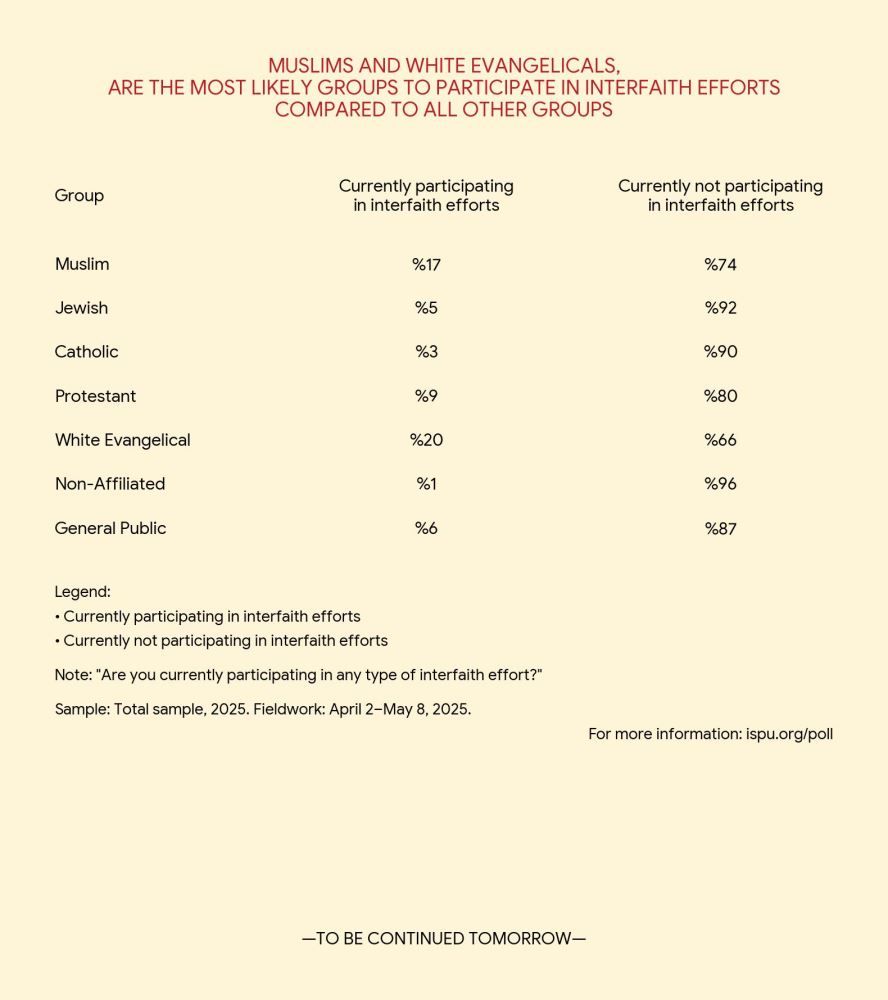
The overwhelming majority of Americans—87 percent of the general public—said they were not involved in any such activity.
The same answer came from 74 percent of Muslims, 92 percent of Jews, and 90 percent of Catholics.
Yet the other side of the picture is even more intriguing.
Two groups stand out as the most active participants in interfaith engagement—and at first glance, the pairing may seem surprising: Muslims and White Evangelicals.
Nearly one in five White Evangelicals and 17 percent of Muslims reported participating in interfaith initiatives.
In other words, the two communities often assumed to stand furthest apart are also among those investing the greatest effort in building bridges.
Even more noteworthy, there is virtually no significant difference by gender, age, or ethnic background among Muslims.
Whether White, Black, Asian, Turkish, or Arab, Muslims display a broadly shared commitment to building relationships with neighbours and colleagues and to communicating their values beyond their own community.
The Perception Gap
At this point, another finding highlighted by the report brings us to the heart of the issue: the perception gap.
According to a 2024 study entitled Promising Revelations, Americans assume that religious people are considerably less tolerant than they actually are.
The public estimates that only about half of Evangelicals and Muslims support religious pluralism.
The reality tells a different story.
Seventy-eight percent of Evangelicals and seventy-five percent of Muslims say they want an America in which everyone is respected regardless of their faith.
Moreover, both communities believe that politicians and the media often distort the public image of their religion.
In other words, people are often less afraid of one another than of the stories they have been told about one another.
Here We Must Pause and Ask an Important Question
If interfaith engagement is increasing, why is Islamophobia still rising?
The report does not ignore this paradox.
Its answer is both sobering and insightful.
Dialogue, by itself, is not a magic wand.
Superficial encounters organised merely for photographs, where difficult questions are politely swept under the carpet, do little to dismantle prejudice.
According to the Shoulder to Shoulder Campaign, effective interfaith engagement must be free from missionary ambitions. It must encourage every community to turn inward first—to confront the discriminatory assumptions within its own ranks—so that internal dialogue can accompany external dialogue.
Learning to live one’s faith not only inside the place of worship but also throughout public life, embracing those beyond one’s own community with a shared moral outlook—that is the essence of the report’s vision of intentional and purposeful interfaith engagement.
In many ways, this echoes Bediuzzaman Said Nursi’s own call to self-reflection.
At the beginning of the last century, he wrote:
“If we were to demonstrate the truths of Islam and the morality of the Qur’an through our conduct and actions—in other words, by living them...”
Today, this is precisely what is most expected of Muslims in America: to make Islamic values visible in everyday life.
Different Communities Require Different Approaches
The report concludes that no single formula can be applied equally to every community. Outreach must be shaped according to each community’s own language, sensitivities, and social context.
There are encouraging institutional examples of this approach already taking shape.
The Bayan Islamic Graduate School, while preparing a new generation of American Muslim leaders, has made both interfaith and intra-faith engagement an integral part of its curriculum.
Meanwhile, the Religious Freedom Institute’s developing initiative known as RivalTrust seeks to move beyond traditional dialogue programmes centred merely on courtesy and agreement. Instead, it aims to equip participants with the ability to build mutual trust under conditions of tension—perhaps one of the most urgent civic skills our increasingly polarised age requires.
Yeni Asya English