Syrian Minister of Religious Affairs Dr. Muhammad Abu al-Khair Shukri: “We pray to Allah to make Bediuzzaman Said Nursi, a devout scholar of God whose knowledge has spread to the East and West of the world, a source of pride for Türkiye and the Islamic world.”
INTERVIEW – İBRAHİM ERSOYLU
Photo: Muhammed Okur
[email protected]
During the 13th International Bediuzzaman Symposium held in Istanbul, we conducted an interview with Syrian Minister of Religious Affairs Dr. Muhammad Abu al-Khair Shukri, focusing on Bediuzzaman Said Nursi and the Risale-i Nur. Here is our interview.
Could you briefly introduce yourself to our readers and New Asya TV viewers?
In the name of Allah, the Most Compassionate, the Most Merciful. All praise belongs to Allah, the Lord of all worlds. May peace and blessings be upon our Master Muhammad, his family and all his Companions. I am Dr. Muhammad Abu al-Khair Shukri, Minister of Religious Affairs of the Syrian Arab Republic. By the grace of Allah, following the end of the former regime, we are now serving in the new Syria.
Our sheikh invited Bediuzzaman to deliver the sermon
How did you become acquainted with Bediuzzaman Said Nursi and the Risale-i Nur?
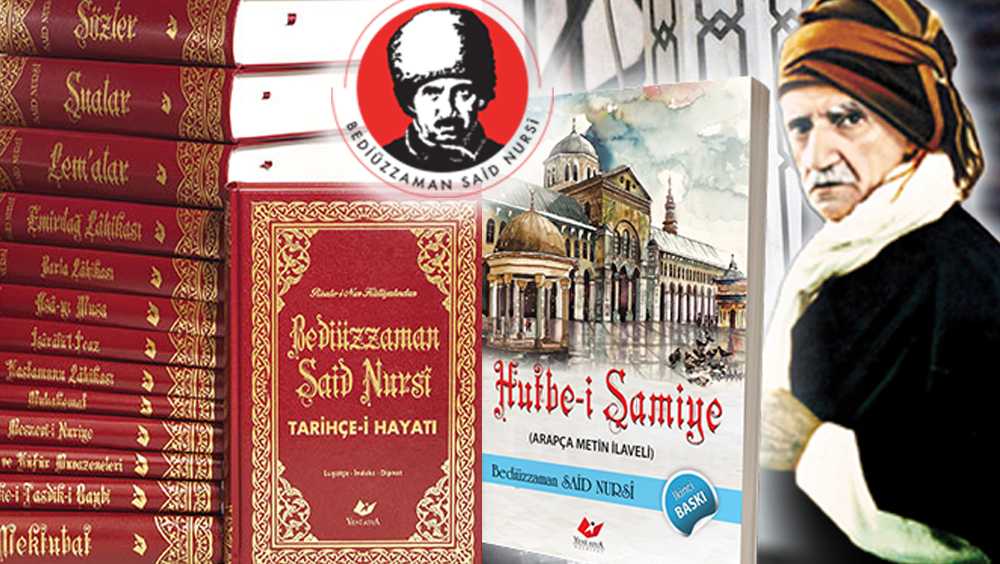
I became acquainted with Bediuzzaman Said Nursi in several ways. Foremost among them is the Damascus Sermon (Hutbe-i Şamiye), which he delivered at the Umayyad Mosque in Damascus approximately 115 years ago. More than ten thousand people and over a hundred scholars from the Damascus region listened to this sermon. It was our sheikh, Bedreddin al-Hasani, one of the leading scholars of Damascus at the time and known as the “Greatest Hadith Scholar” (Muhaddis al-Akbar), who invited Nursi to the pulpit and praised his sermon.
We need to return to Ustad Nursi's thought
What aspects of the Damascus Sermon have particularly impressed you?
The Damascus Sermon can be regarded as an exemplary text that diagnoses the ailments of society today, such as ignorance, poverty, corruption, despotism and despair, and reveals their effects on individuals and society. As the Islamic world, we need to return to Ustad Nursi's thought. I also came to know him through the Risale-i Nur. Today, the Islamic Ummah needs this thought, which diagnoses the ailments of Muslim societies and shows us their remedies.
Are the ailments identified in the Damascus Sermon as existing in the Islamic world at that time also present in Muslim societies today?
Unfortunately, these ailments are still present in our societies today. Bediuzzaman showed that their remedies could be found in the pharmacy of the Holy Qur'an and the Sunnah of our Prophet. The Qur'anic solutions that helped reform society during the time of our Prophet, his Companions and the Tabi'in (the generation that followed the Companions) remain valid for our societies today. The ailments are the same, and so are the remedies. What we need to do is read the Qur'an with understanding and contemplation, derive remedies from it and apply them correctly in society. The Qur'an is a healing for hearts and souls, for individuals and society.
We can share our moral values with the whole world
In your view, what is the way for Muslims to overcome the difficulties they are facing?
In my view, the way to salvation lies in returning to Islamic morality, education and way of life. We have values of which we are proud and which we can share with the world. If there is a gap between us and others in material terms, that gap can be closed over time. However, we can share our moral values with the whole world.
Said Nursi states that if we Muslims were to demonstrate the truths of faith and the morality of Islam through our actions, followers of other religions would enter Islam in multitudes, and even the continents and countries of the world would embrace Islam. Do you agree with this view?
Yes. The most effective way of spreading Islam is to embody its morality. People do not want merely to hear words; they also want to see those words reflected in everyday life. Conduct has a greater impact on people than words or sermons. We must uphold the values of truthfulness, trustworthiness, chastity and other Islamic moral principles that we have inherited from our Prophet.
Could you briefly explain the activities you are carrying out in Syria as the Ministry of Religious Affairs?
As the Syrian Ministry of Religious Affairs, we organise one Friday sermon every month under the title “Sermon on Moral Values”. In these sermons, we address values such as truthfulness, trustworthiness, chastity, cleanliness, love, tolerance, peaceful coexistence, maintaining family ties, knowledge and compassion. These sermons are distributed to all mosques with the aim of strengthening the unity and moral character of the Ummah and promoting these values throughout society.
New Syria aims to be built on Islamic values and morality
When we visited Aleppo last year, we saw large numbers of young people attending prayers in the major mosques. This was truly encouraging. How would you assess the situation in the new Syria?
Praise be to Allah, He has enabled Syria to free itself from the former regime and regain its freedom. The former regime had caused great harm to the country, its people, its buildings and social life. The new Syria aims to open itself to the world while preserving its Islamic values and moral principles, and to build its future on values and morality. We want to adopt from other countries whatever can benefit us, while sharing with them the beneficial words, morality and values that we possess.
We have made it possible for the Risale-i Nur to be read
Last year, we heard that the Syrian Ministry of Religious Affairs had instructed mosque imams to read and discuss the Risale-i Nur in Syrian mosques and encourage young people and citizens to read it. Is this true?
In the new Syria, we have made it possible for the Risale-i Nur to be read and opened the door to freedom of thought and the dissemination of knowledge and light. Following our liberation, we issued the Islamic Discourse Unity Charter, which aims to establish unity and bring the voice of the Ummah together. In matters of Islamic jurisprudence, we have adopted the four schools of thought: Shafi'i, Hanafi, Maliki and Hanbali. In matters of Islamic creed and scholarship, we also embrace the traditions of Ash'arism, Maturidism and Ahl al-Hadith.
So you have opened the way for those who wish to engage in positive religious activities, without advocating violence, within the tradition of Ahl al-Sunnah wa'l-Jama'ah?
Yes. We are opening up opportunities for everyone who wishes to spread knowledge and light. In the past, some of these books were banned; today, however, we encourage works that uphold moderation and balance. This is because our country is a land of moderation. Allah says: “Thus We have made you a middle nation.” We must study Islamic thought in depth and learn from Muslim thinkers and scholars, particularly Imam Nursi, how to find Qur'anic solutions to the ailments of society. We need to put these remedies into practice and benefit from them.
I invite everyone to study the Risale-i Nur more deeply
What message would you like to convey to the readers of Yeni Asya newspaper and the viewers of New Asya TV?
I invite everyone to study the Risale-i Nur, the Lem'alar (The Flashes) and the Damascus Sermon more deeply, and to gain a better understanding of Imam Nursi's thought. We should learn Qur'anic remedies from him and put them into practice in society. At the symposium, I saw brothers who had come to attend the conference, loved Imam Nursi and were striving to live by Islamic morality. The finest example a person can offer to others is their own moral conduct. People pay more attention to actions than to words.
We pray to Allah to make Bediuzzaman Said Nursi, a devout scholar of God whose knowledge has spread to the East and West of the world, a source of pride for Türkiye and the Islamic world. The participation of representatives from more than sixty countries in the conference shows that this is the moderate and balanced Islamic thought that we are all seeking.
– On behalf of Yeni Asya, we would like to thank you very much for giving us this opportunity.
– I thank you as well. May Allah be pleased with you.
Yeni Asya English