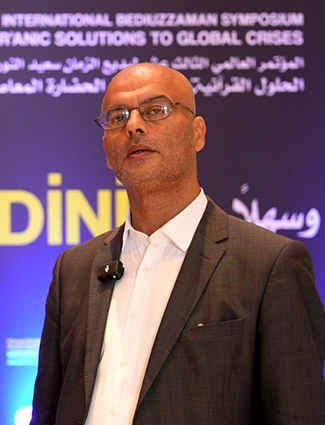
In his message related to the Bediuzzaman Symposium titled "Quranic Solutions," Muin Yasin stated, "I believe that only Islam offers justice in the world. This is because Islam is based on divine guidance and a socio-economic and political order where human beings are not masters, but trustees and vicegerents."
INTERVIEW - HASAN GUNES
[email protected]
PHOTOS: MUHAMMED OKUR - YENI ASYA
Welcome to this symposium, Mr Muin Yasin. How are you? It is a pleasure to speak with you. Could you tell us a little about yourself?
My name is Muin Yasin, and I am the director of Global Vision 2000, an independent think tank established in the United Kingdom. It has remained active for 25 years, which is remarkable. Our work focuses primarily on the Islamic world, but we also examine geopolitics and political economy. We organise conferences and have built an archive of more than 20,000 videos about the Islamic world. We also run a website and a YouTube channel.
What is your view of the global crisis and its impact on the Islamic world and the wider world?
I could spend all day answering that question. The world is certainly in crisis. Many people, including figures associated with the World Economic Forum and people such as Mark Carney, have said that the world order established after the Second World War is no longer functioning as it once did and is, in fact, collapsing. Institutions such as the United Nations, the IMF and the World Bank, as well as international trade relations, are part of a system that has changed. Its rules are increasingly seen as biased and irrelevant.
I think there is broad agreement, in both the Muslim and non-Muslim worlds, that the international order established in 1945—the Bretton Woods order and the system associated with it—is breaking down. This is a dangerous period. When an established order collapses, it creates an imbalance and uncertainty.
One could trace this process back to the collapse of communism and the Soviet Union after 1989. I would argue that global disbelief (kufr), as I see it, has two faces: global communism and global capitalism. I believe global capitalism is also collapsing, because neither system offers solutions to the world's problems. Both are based on man-made, secular and materialist ideologies.
In my view, neither capitalism nor communism can provide answers to social justice. My message today relates to the conference on Bediuzzaman, whose title is “Qur’anic Solutions”. I believe that Islam alone offers a solution for justice in the world, because it is based on divine guidance and a socio-economic and political order in which human beings are stewards, or caliphs, rather than masters.
Why is Istanbul and Türkiye important to you? Why do you prefer to come here?
Ideally, I would be in Mecca and Medina; to me, they are the perfect places. God willing, I still hope to go to Mecca. In the meantime, I have visited Istanbul before, and I think there is more freedom here, particularly freedom of expression. Istanbul is also a centre for the Middle East and the wider world. London and New York are not the centre of the world.
Education is very important, but the Islamic world faces major educational challenges. We need to understand Qur’anic solutions. What is your view of education, reading the Qur’an and understanding its message?
This is a very broad subject. I do not want to use terms such as usul al-fiqh or Sharia in this discussion. We are an Islamic think tank, and we draw inspiration from the Qur’an—I want to emphasise the word “inspiration”. I am not a religious scholar, and I do not claim to interpret every word of the Qur’an.
At the same time, religious scholars may not always understand the modern world, including technology, economics, political economy and geopolitics. We draw inspiration from the spirit of the Qur’an. Its message, as I understand it, is that the world should be governed in the name of Allah, according to His way and system.
We need to understand the Qur’an, but we also need to understand how the global economy, political economy and geopolitics actually work. What secularism tells us does not necessarily reflect how the world really operates.
Thank you. Our time is limited, but it has been a pleasure speaking with you. God willing, we can discuss another important subject next time. Thank you very much.
Thank you very much.
Yeni Asya English