Dr. Yaser Abdrabu Muhammad Abu Huta answers the question, “What impresses you most about Said Nursi’s thought?” by saying, “What impresses me most, when I compare him with other scholars, is that he was a scholar who practised what he preached.”
INTERVIEW: İbrahim Ersoylu
PHOTOGRAPHS: Erhan Akkaya
INTRODUCTION
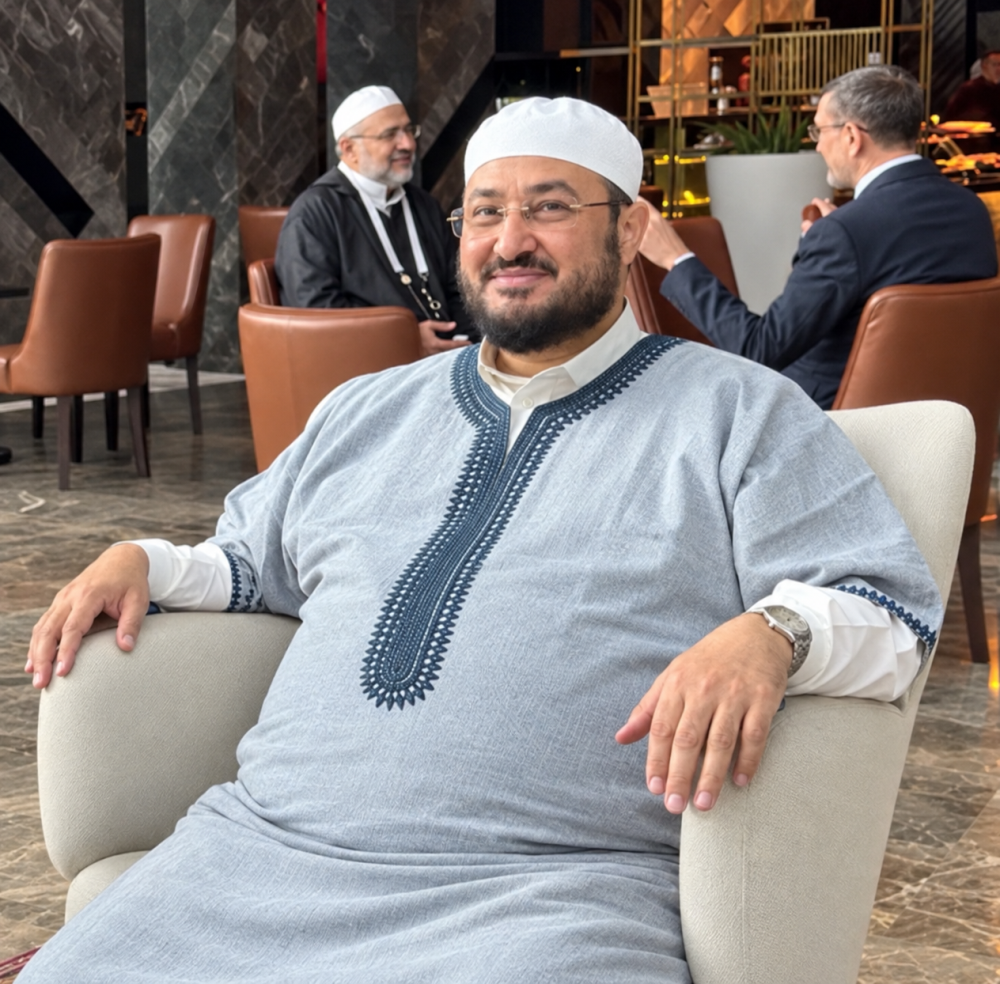
We spoke with Dr Yaser Abdrabu Muhammad Abu Huta, who presented a paper at the Bediuzzaman Symposium held in Istanbul. Speaking about Bediuzzaman Said Nursi, Dr Abdrabu said, “What impresses me most, when I compare him with other scholars, is that he was a scholar who practised what he preached.” He expressed his views on Bediuzzaman clearly, stating, “I believe that he was a mujaddid (renewer of the faith) who fulfilled the duty entrusted to him by Allah at a time when religious values and Islamic identity were under intense pressure.” Here are Dr Abdrabu’s further reflections.
On behalf of Yeni Asya, a newspaper published in Türkiye, we would like to welcome you to our country.
Thank you. It is a pleasure to be here.
Could you tell us a little about yourself?
I am your brother, Dr Yaser Abdrabu Muhammad Abu Huta, a citizen of Saudi Arabia and a lecturer in Hadith studies. I studied at Umm Al-Qura University in Makkah for 19 years. I studied at the Faculty of Hadith and the Department of Sunnah at the Grand Mosque in Makkah. I am currently the Dean of the Faculty of Islamic Studies at the Asian Universities network.
Where is your university based?
Our university provides education online. It has branches in Guinea, Somalia and Sudan, as well as a representative office in Türkiye.
I DISCOVERED THE RISALE-I NUR AT AN ISLAMIC BOOK FAIR
How did you first encounter Said Nursi and the Risale-i Nur?
My first encounter with the Risale-i Nur was at an Islamic Book Fair held in Jeddah. The fair takes place every year and attracts publishers from many countries around the world.
There, I saw a stand displaying the works of Said Nursi. Until then, I knew nothing about him. One of the Turkish brothers at the stand spoke Arabic very well. He told me about Said Nursi, his ideas and the Risale-i Nur.
I looked through some pages of the books and came across expressions that genuinely impressed me with their beauty and depth. I did not buy any books at the time, but I began researching Said Nursi.
This was about 20 years ago. At that time, Said Nursi’s thought and works were not widely known in Egypt, Saudi Arabia or other Arab countries. His books may have been available in certain places, but I had not had the opportunity to meet his students or people who shared his thought.
Later, by Allah’s decree, I met a wonderful person in Madinah, Dr Ashraf al-Darafili. A Turkish brother was with him. We sat together at a hotel and had a conversation. I invited them to visit me in Makkah, and they kindly accepted.
They came to my home and presented me with a complete collection of the Risale-i Nur, consisting of several large volumes. That was how my wonderful relationship with the Risale-i Nur began.
Then, about two years ago, I was invited to Türkiye. I came and stayed here for more than five days. Our relationship continued, and subsequently I was invited to the 13th Bediuzzaman Symposium, where I presented my paper.
I BELIEVE SAID NURSI WAS A MUJADDID
What impresses you most about Said Nursi’s thought?
What impresses me most, when I compare him with other scholars, is that he was a scholar who practised what he preached. A scholar may write excellent books from which everyone can benefit. However, if that scholar is not present among the people and does not engage with them directly, his influence may remain limited. A scholar who truly influences people is one who lives among them, shares their lives and guides society through his own life, conduct, ideas, direction and teaching.
A person’s behaviour is one of the most important indicators of the ideas and beliefs they hold. Anyone who wishes to change society must first demonstrate that change in their own life. I have read Said Nursi’s works in their Arabic translations, and even so, I can feel an influence in them that could truly be described as “light upon light”. His words are deeply moving. They appeal not only to people’s souls but also to their minds. He brings reason and the spirit together.
Moreover, his words are consistent with the way he lived. Said Nursi was a man who struggled during a difficult period for his nation and the Muslim ummah, making great sacrifices to preserve Islamic identity.
I believe that he was a mujaddid who fulfilled the duty entrusted to him by Allah at a time when religious values and Islamic identity were under intense pressure. Said Nursi truly impressed me because he personally experienced the crises of his age and the challenges facing the ummah. We could compare him to someone trying to save people from drowning.
If an issue exists only in a person’s mind, its influence may be limited. Said Nursi, however, was someone who lived the issues he addressed through his mind, heart and actions. That is why his influence on society was so profound. One of the clearest indications of this is that people who embrace his thought can now be found in many parts of the world.
I had not previously realised that Said Nursi had such a large following among his students across the world. The fact that people carrying his message can be found on different continents, in different countries and in different cities demonstrates the powerful influence of his ideas.
This is because he addressed the problems of his age. His words were not detached from real life. On the contrary, he had analysed the conditions of his time with great insight.
TAKE SAID NURSI’S WORKS TO A WIDER AUDIENCE
What message would you like to convey to Yeni Asya readers?
My advice to readers is that they should make greater efforts to introduce the Risale-i Nur and Said Nursi’s thought to others. They should establish closer links with cultural institutions, universities, libraries and scholarly circles throughout the Islamic world.
These works should be donated to such institutions wherever possible. Today, a very large younger generation is not sufficiently familiar with Said Nursi and the Risale-i Nur. We need to build a bridge between the older and younger generations. Those who understand the past should pass on what they have learned to the next generation. A society without a firm connection to its past cannot build a sound present or future.
Therefore, my appeal to the institutions promoting Said Nursi’s works and ideas is this: make greater efforts and take his works to a wider audience. The message Said Nursi offered to the Islamic world and humanity is a legacy worthy of reaching all Muslims.
We in the Arab and wider Islamic world also regard the Turkish nation with great respect and appreciation. The Ottoman Empire was an important part of the Islamic world for approximately 800 years and rendered great services to Islamic civilisation.
When we study history, we can clearly see the contributions made by the Turks to the Islamic world. The mosques and Islamic monuments found in many European cities are also significant examples of this legacy.
I pray to Allah that people will emerge from this nation once again who can revive Islamic values and serve the ummah.
THE OTTOMAN LEGACY MATTERS TO THE ENTIRE ISLAMIC WORLD
You mentioned that there are differing views of the Ottomans and the Turks in the Arab world. What is your assessment?
There are two different approaches to this issue in Arab countries. The first views the Ottoman Empire and the Turks as colonial powers. The second maintains that the Ottoman Empire was an Islamic state and that Ottoman rule should not be characterised as colonialism.
In my view, portraying the Ottoman Empire’s place in Islamic history through the framework of colonialism is part of an approach intended to discredit Islamic history and civilisation. If we portray our past negatively, we prevent younger generations from taking pride in their identity, history and ancestors. The Ottoman legacy is important not only for Türkiye but for the entire Islamic world.
THE DUTY OF SCHOLARS IS TO GUIDE SOCIETY
How do you assess scholarly gatherings of this kind held in Türkiye?
It is a significant development that international gatherings of this kind can now be held in a country where Islamic activities were once severely restricted. I believe this is a blessing from Allah.
It is also important that an environment now exists in Türkiye in which ideas can be expressed. Of course, the security of the state and society must be protected. We do not wish to target the state or undermine the country’s security. On the contrary, the duty of intellectuals, scholars, thinkers, writers and journalists is to guide society, express their concerns about matters they believe to be wrong, and contribute to making the country better and improving its prospects.
The responsibility of a society’s intellectuals is to safeguard the existence of the state and society, contribute to the country’s security, and help it progress in different areas of life.
Could you give an example of this from Islamic history?
We find a very good example during the caliphate of Umar ibn al-Khattab (may Allah be pleased with him). When Umar sought to impose a limit on the amount of mahr (the bridal gift given to a woman in marriage), a woman challenged him and reminded him of a verse from the Qur’an.
When the woman cited the verse conveying the meaning that husbands should not take back the bridal gifts they have given their wives, Umar acknowledged that she was right.
This incident is a fine example of how people in an Islamic society should be able to speak up and tell rulers and scholars what they believe to be correct. What matters here is that the truth should emerge and society should be guided towards what is better.
Thank you very much, Professor.
Thank you, too. May Allah reward you. In fact, today I have benefited more from you than you have from me. You have given me much of the historical information I needed about Said Nursi and the Risale-i Nur. Thank you.
Thank you as well.
Yeni Asya English