Dr. Abdullah Al-Muslih said, “Ignorance, disunity and poverty are among the greatest enemies of Muslims. We must fight against them. For example, we should combat poverty through industry, agriculture and production; ignorance through knowledge; and disunity through understanding and unity.”
INTERVIEW: İbrahim Ersoylu
PHOTOGRAPHS: Erhan Akkaya
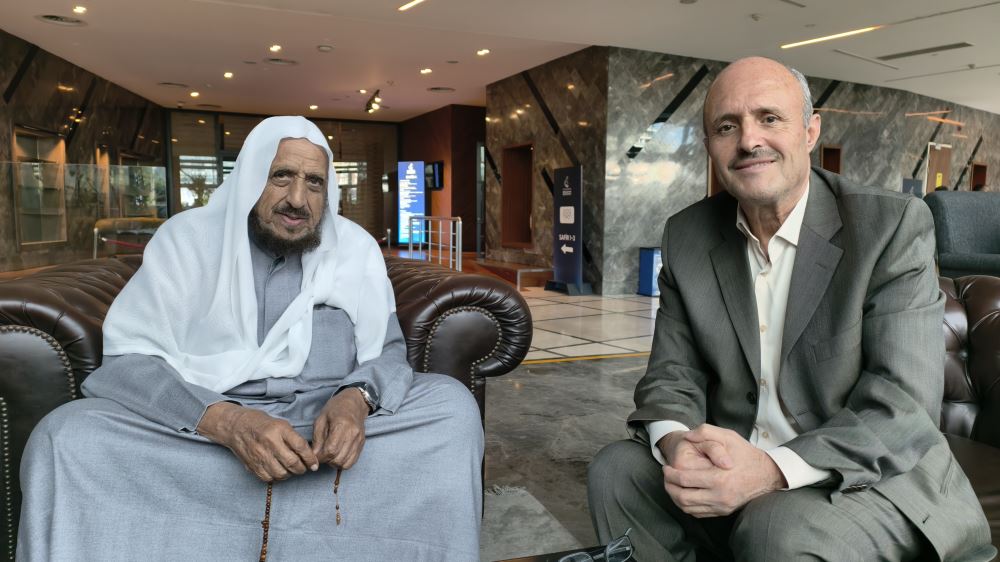
We spoke with Dr. Abdullah Al-Muslih, who attended the 13th Bediuzzaman Symposium organised by İİKV.
.jpg)
My name is Ibrahim Ersoylu. I am one of the writers for Yeni Asya, an Islamic newspaper. I graduated from a faculty of theology.
The mission of our newspaper is to present, in a clear and beautiful way, to people throughout the world, particularly in Türkiye and the Islamic countries, the truths of faith and the Qur’an explained and demonstrated by Bediuzzaman Said Nursi.
With your permission, we would like to conduct a brief interview with you on this subject on behalf of Yeni Asya.
Dr. Abdullah Al-Muslih: Of course. Please go ahead.
First of all, welcome to Türkiye. We would like to introduce you to our readers. Who is Dr. Abdullah Al-Muslih? Where are you from? What scholarly or religious studies have you undertaken? What kind of activities do you carry out in the Islamic and religious fields?
I am your brother, Dr. Abdullah Al-Muslih. I am a Saudi citizen.
I currently serve as Secretary-General of the World Council of Islamic Call and Relief.
The council is based in Cairo and brings together approximately 70 Islamic organisations from across the Islamic world. Its purpose is to coordinate the activities of these organisations, promote cooperation among them, and contribute to the implementation of charitable and educational projects throughout the Islamic world.
So you also carry out educational and relief activities?
Yes.
How did you first come to know Bediuzzaman Said Nursi?
I came to know Bediuzzaman Said Nursi through Sheikh Salih Özcan, a righteous and distinguished man.
Salih Özcan?
Yes. I met Ustad Salih Özcan in Riyadh. At the time, I was a student at the Faculty of Sharia in Riyadh. Through him, we became acquainted with this community and with the personality of Said Nursi. May Allah have mercy on him. We learned about his efforts, his method, his work, his patience, the services he carried out seeking reward from Allah, and his steadfastness.
Allah later made it possible for great communities to emerge, people who were nurtured by his Risale-i Nur treatises, benefited from them, and drew upon his knowledge.
In your view, what distinguished Said Nursi from other prominent scholars of his time?
All the scholars of the past who distinguished themselves and remained upon the truth were people of goodness.
However, every sheikh, every caller to Islam, and every person whom Allah enables to guide others has circumstances unique to them.
Each has their own circumstances, conditions, period, place, and the particular realities of the life they lived.
Nevertheless, they all drew upon the Book of Allah and the Sunnah of His Messenger.
They then shaped what they had learned from the Qur’an and the Sunnah according to the circumstances in which they lived and applied it to their lives.
So, fundamentally, they all proceeded from the Qur’an and the Sunnah, did they not?
Yes. They adhered to the Qur’an and the Sunnah and conveyed their teachings to people.
Bediuzzaman Said Nursi stated that the deepest crisis of the modern age is not merely political or economic, but fundamentally a crisis of faith and morality. What is your view on this?
I believe this statement expresses the truth. When people reform themselves, goodness follows in the political, economic and social spheres as well.
In terms of principles, values and morality, human beings are at the centre of both good and evil on Earth.
Allah Almighty says:
“Corruption has appeared on land and sea because of what people’s own hands have wrought.”
Good comes about through people, and evil also emerges through people.
Allah has also taught us something even more important: He has shown us how to reform the human condition.
What does Allah say?
“Indeed, Allah does not change the condition of a people until they change what is in themselves.”
To change ourselves, we must measure ourselves against a method and examine our lives in its light.
.jpg)
What is this method?
It is the method that Allah has undertaken to preserve.
Allah Almighty says:
“Indeed, it is We who sent down the Reminder, and indeed, We will preserve it.”
The Qur’an and the Sunnah are the method preserved by Allah.
Our duty is to submit ourselves to this method. In other words, we should say:
“O Book of Allah, O Sunnah of Muhammad (peace and blessings be upon him), guide us and teach us.”
Teach us the method we must follow in matters of creed, religious life, values, morality, economics, politics and every other aspect of life.
The Qur’an and the Sunnah provide us with guidance, and we act accordingly.
In the sermon known as the Damascus Sermon, which Bediuzzaman Said Nursi delivered at the Umayyad Mosque, he identified ignorance, poverty and disunity as the three greatest enemies of the Islamic world. Do you share this assessment?
Yes. Ignorance, disunity and poverty are among the greatest enemies of Muslims.
We must fight against them. For example, we should combat poverty through industry, agriculture and production; ignorance through knowledge; and disunity through understanding and unity.
All of this is absolutely true.
However, I would like to ask you something: Where should we begin?
Should we begin by fighting poverty?
By overcoming disunity?
Or by combating ignorance?
It is true that these are our enemies. But we must determine where to begin.
Where should we begin?
We should begin by eliminating ignorance within the Muslim community.
How can this be achieved?
Through education. Through proper education and a sound understanding of Islamic outreach.
In other words, an education based on the Qur’an and the Sunnah?
Certainly. An education that is consistent with the Qur’an and the Sunnah.
We have no other method, because the Qur’an and the Sunnah come from Allah, who created us.
Let me give you an example.
Who made this watch I am wearing? Where was it made? It was made in Egypt.
If a very small fault were to develop in this watch, who would be best able to repair it?
The person who made it.
Who made us?
You, I and all human beings are Allah’s handiwork.
We are Allah’s handiwork.
Therefore, Allah knows best how to put our affairs right.
In his discussions of justice, Bediuzzaman Said Nursi distinguishes between absolute justice and relative justice. How should modern policymakers apply this distinction when faced with systematic human rights violations or refugee crises?
When a person lives on Earth as a human being rather than like a beast, the situation changes.
When I recognise that the person standing before me is a human being, I acknowledge their humanity; I do not regard them as a beast. Worse still is to see myself as a beast and the other person as prey.
If I see myself as a lion and the other person as a rabbit, I regard them as prey.
This is where the problem arises.
But when I recognise that the person before me is a human being, I must treat them with compassion and justice.
Justice is a responsibility that rests upon me as a human being.
I am a human being, and I recognise the person before me as a human being too. In that case, justice must govern both of us.
This is justice according to the scales established by Allah.
For Allah has revealed this principle of justice:
“Indeed, Allah commands justice, excellence and giving to relatives.”
Bediuzzaman suggests that Islamic states should establish a common union. He speaks of a structure consisting of united Islamic republics in which each state remains independent in its internal affairs but is bound by the union in its external affairs. He compares this structure to the system in the United States. What is your view on this?
This is a matter you should address to political leaders.
So you regard this as a call to political leaders?
Yes.
Finally, is there a message you would like to convey to Yeni Asya readers?
There is a verse in the Book of Allah which, if we kept it before our eyes, would be one of the greatest lessons of our time.
It is a commandment that Allah gave to all the prophets.
Allah Almighty says:
“We have certainly instructed those who were given the Scripture before you, as well as you yourselves, to fear Allah.”
My advice to all my brothers in Türkiye and throughout the Islamic world is the very same advice that Allah gave to the prophets, the righteous and all humanity:
“We have certainly instructed those who were given the Scripture before you, as well as you yourselves, to fear Allah.”
Thank you very much for sharing your views with us. May Allah be pleased with you.
May Allah be pleased with you too.
Professor, which television channels have you presented programmes on in the past?
I worked for 20 years at Saudi Arabia’s Channel One.
I also worked for 23 years at Iqra TV.
Later, I worked for 12 years at Al-Resalah TV.
I am getting old now. How much longer can I continue?
MashaAllah. I also used to follow your programmes on the channels you mentioned. I watched your programmes on Arab television and greatly enjoyed them. MashaAllah, your programmes were very successful.
Alhamdulillah.
May Allah be pleased with you, Professor.
May Allah be pleased with you too.
When do you plan to publish the interview?
God willing, within a week.
May Allah protect you, Professor.
Thank you. And you too.
Yeni Asya English